Guide
How to start a container vegetable garden for under $60
A real budget breakdown for a first container garden — what to buy, what to skip, and a six-week plan that gets you harvesting instead of shopping.
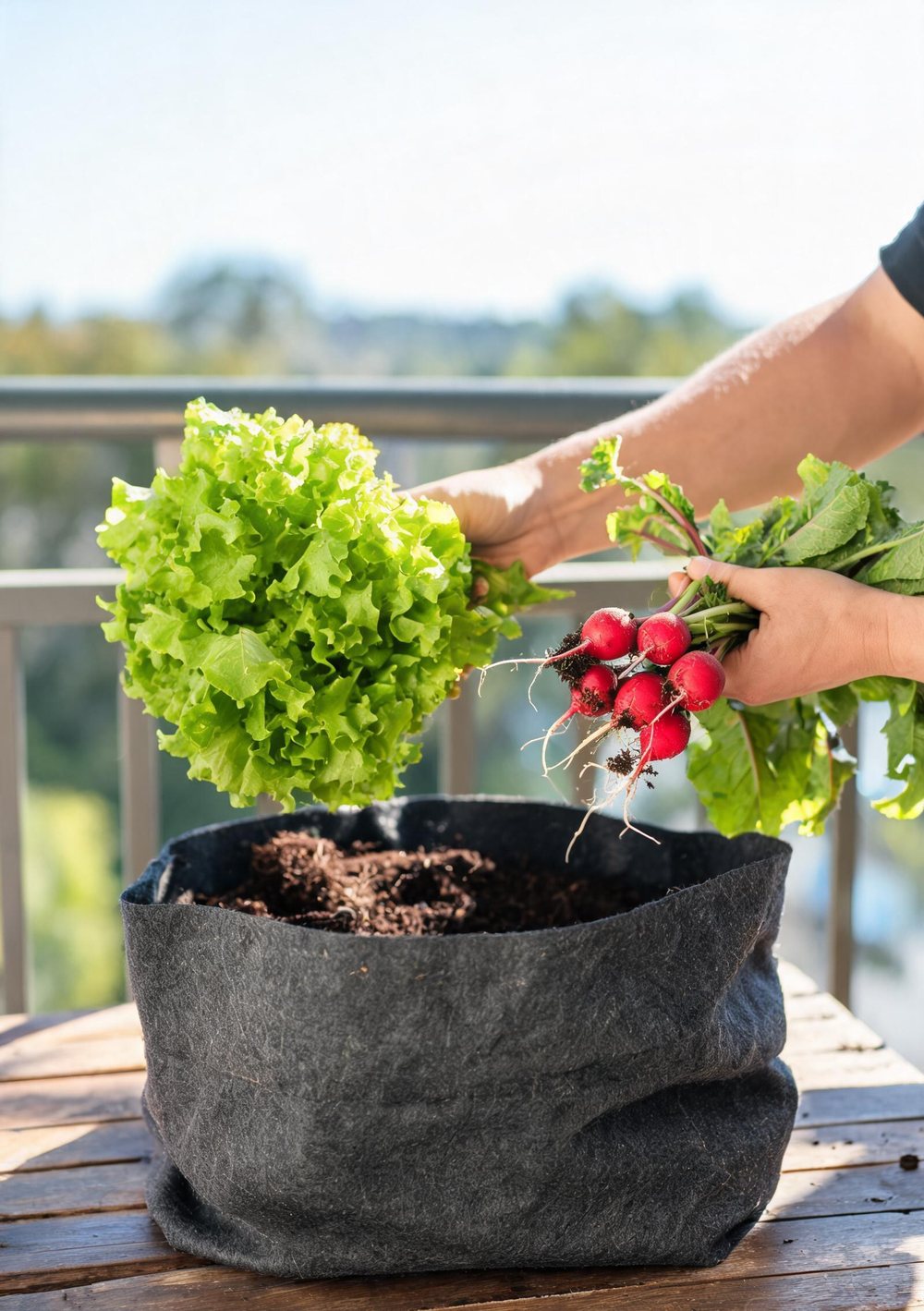
How to start a container vegetable garden for under $60
Most "cheap garden" guides quietly assume you already own a wheelbarrow, a hose, and a shed. If you are starting
from a balcony and a debit card, the real number is smaller than you think — and most of the money should go into
two things only: container volume and potting mix.
Here is a complete first-season setup for roughly $55–60, plus what to deliberately not buy.
What actually costs money
- Two 5-gallon fabric grow bags — about $12. Fabric bags drain well, air-prune roots, and fold flat for storage, which matters on a balcony.
- Two 3-gallon grow bags — about $8. These are for herbs, greens, and beans.
- One 2-cubic-foot bag of potting mix — about $15. That is roughly 15 gallons, enough to fill all four pots.
- Four packets of seed — about $10 if you avoid boutique varieties. Radish, lettuce, bush bean, and one cherry tomato will feed a household.
- One quart of liquid organic fertilizer — about $12. This is not optional in containers.
- A $0 stake — a bamboo cane or a repurposed broom handle.
Total: $57. That is the whole setup, and the pots and mix are reusable for several seasons.
What to skip in year one
- Seed-starting heat mats and grow lights. If you have one window with four hours of light, direct-sow lettuce, radish, and beans and buy a tomato transplant instead. You will save $60 and lose nothing.
- Soil test kits. They are calibrated for field soil and give misleading readings in potting mix.
- Raised beds, trellises, and obelisks. A $3 bamboo cane and some twine do the same job for a season.
- Fancy ceramic pots. They look better and perform worse: heavy, expensive, and they cook roots in afternoon sun.
- A full-range fertilizer collection. One liquid feed, used consistently, beats five bottles used randomly.
The single most common way beginners waste money is buying many small pots. Four pots with real volume will
out-produce twelve decorative 8-inch pots every time, because roots — not leaves — set the ceiling on yield.
The six-week plan
Week 0 — decide where the pots go
Watch your intended spot for one full day before spending anything. You need to know when the sun arrives and when
it leaves. A spot that gets sun from 9am to 1pm is a greens spot, not a tomato spot. Our guide on
measuring balcony sunlight covers this properly.
Week 1 — fill and plant the cool crops
Fill the two 3-gallon bags with mix, water until it settles, and sow lettuce and radish directly. Radish germinates
in three days, which gives you an early signal that the setup works. Do not fertilize yet — the mix already contains
some nutrition.
Week 2 — start the warm crop
If you are buying a tomato transplant, wait until nights are reliably above 50°F. If you are sowing tomato seed
indoors, start it now in the smallest container you own and keep it in the brightest window.
Week 3 — sow beans
Bush beans go directly into a 3-gallon bag once the soil is warm. Do not bother starting them indoors; beans
transplant badly and lose two weeks recovering.
Week 4 — first fertilizer
Begin a half-strength liquid feed every two weeks. Container plants run out of nutrients far faster than garden
soil because every watering leaches a little out the bottom.
Week 5–6 — thin, stake, and eat
Thin lettuce to 8 inches and radish to 3 inches. Put a stake next to the tomato the day you plant it, not the day
it falls over. Harvest radish at day 28 — waiting for a bigger root gets you a woody one.
What to grow first, in order of payoff
- Radish. Ready in 28 days, costs pennies, and tells you whether your watering is even.
- Loose-leaf lettuce. Cut-and-come-again for six weeks from a 2-gallon pot.
- Bush bean. Fixes its own nitrogen, needs no staking, and gives 50+ pods per pot.
- Cherry tomato. The most valuable crop per pot, but also the thirstiest — it needs the 5-gallon bag.
Check the planting calendar for your zone before sowing any of these. The dates move by six
weeks between zone 4 and zone 9, and that difference is the entire reason first attempts fail.
The three mistakes that eat the budget
- Underwatering in July and overwatering in April. Both look like "the plant is dying". Lift the pot: light means
dry, heavy means wet. Water by weight, not by calendar.
- Reusing garden soil. It compacts into concrete in a pot and brings in weeds and root pests. Potting mix is not a
luxury; it is the growing system.
- Not feeding after week four. Slow-release fertilizer in the mix runs out exactly when the plant starts
producing. That is when people conclude "containers don't work".