Guide
How much sun does your balcony actually get? Measure it in one day
A one-day method for measuring direct sun on a balcony, how aspect and season change the answer, and which crops suit 3, 4–5, or 6+ hours.
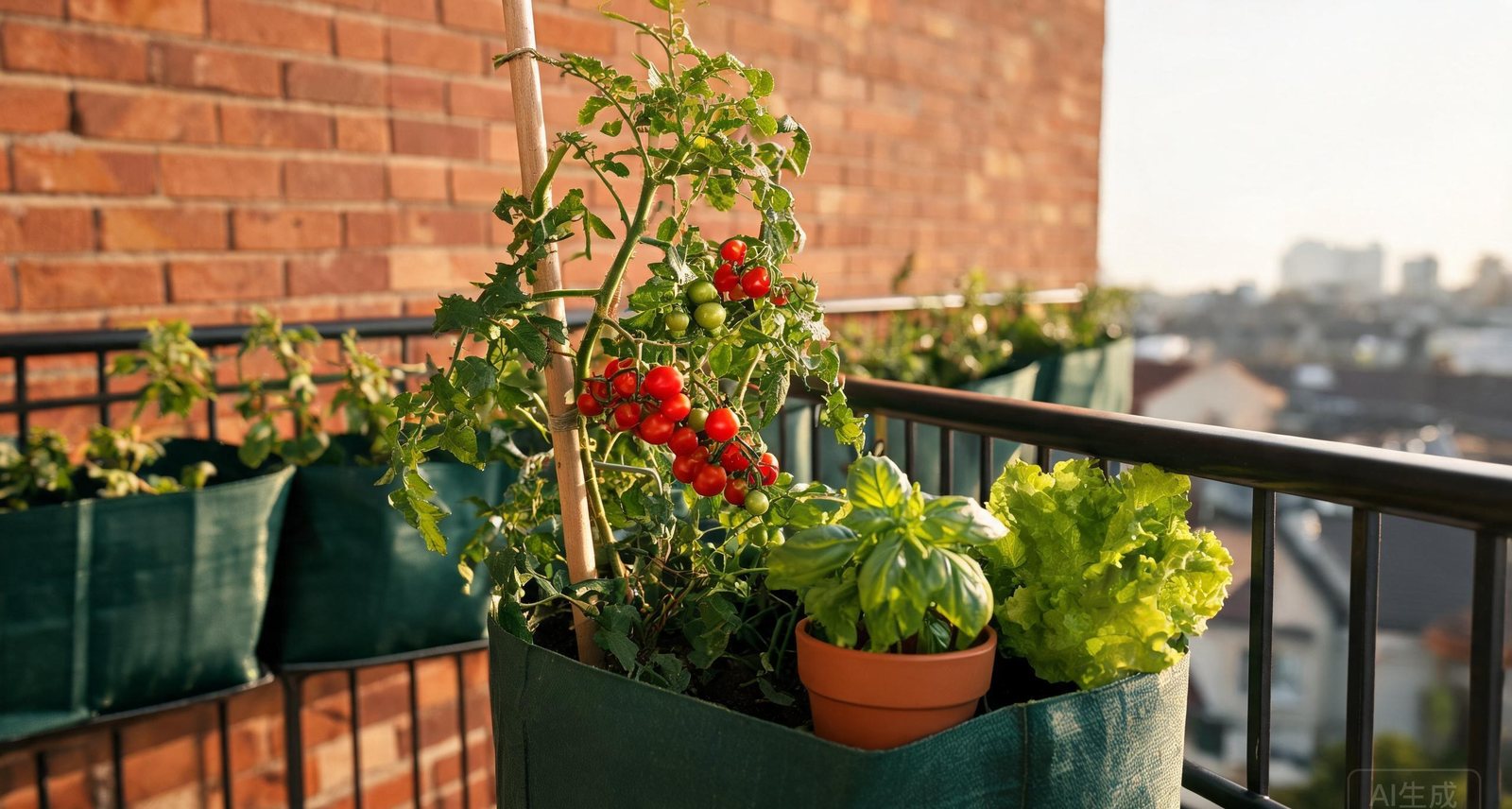
How much sun does your balcony actually get? Measure it in one day
"Full sun" means six or more hours of direct sunlight. Not bright shade, not reflected light, not "it looks sunny".
This is the number that decides whether you grow tomatoes or lettuce, and almost nobody measures it. A balcony
facing the wrong way will never produce a tomato no matter how good the potting mix is.
The one-day method
You need one clear day, a phone, and something to mark the pot's position.
- Put an empty pot exactly where the plant will go. Mark the spot with tape.
- From sunrise to sunset, check the pot once an hour. Take a photo each time from the same angle.
- In each photo, look at the pot's shadow. If the pot casts a hard-edged shadow, that hour counts as direct sun. If the shadow is soft or absent, it does not.
- Count the hours with a hard shadow. That is your real sun number.
Do it once in late spring and once in early autumn. The answer will be different, and the difference is usually
larger than people expect — a balcony can be a tomato site in June and a lettuce site in October.
A cheap light meter app will give you a lux number, but it cannot tell you how many hours are direct. The photo
method is slower and far more accurate for this specific question.
What your compass direction actually means
In the northern hemisphere:
- South-facing — the best case. Direct sun most of the day, including midday when intensity peaks. Tomatoes, peppers, cucumbers, and squash belong here.
- East-facing — morning sun only, typically 4–6 hours. Excellent for lettuce, kale, spinach, herbs, and root crops. Morning sun dries dew early, which reduces disease.
- West-facing — afternoon sun, 4–6 hours, and much hotter. Good for heat-lovers, but small pots dry out fast and seedlings scorch in June.
- North-facing — little or no direct sun. Grow leafy greens and herbs, and accept that fruiting crops are not realistic.
A balcony can also be split: the end nearest the railing often gets an hour or two more than the wall end. Measure
in the exact spot, not on the balcony as a whole.
Three things that change the number
- Season. In winter the sun sits lower and shadows from the building opposite get much longer. A spot with six hours in June may get two in November.
- Overhang and railings. A solid railing or an upstairs balcony above you can cut two hours off a south-facing spot. Watch for the shadow line moving across the floor.
- Reflected heat. A light-coloured wall behind the pot reflects light and heat. It can push a plant from "not quite enough sun" into "enough", but it also raises leaf temperature and water demand. Reflected heat is why west-facing balconies cook small pots.
What you can grow at each level
- 2–3 hours direct: lettuce, spinach, kale, chives, mint, parsley. Manage expectations on size.
- 4–5 hours direct: the above plus radish, carrots, bush beans, basil, strawberries in a large pot.
- 6–8 hours direct: everything in this list. Cherry tomatoes, peppers, cucumbers, and zucchini become realistic.
- 8+ hours, hot and reflected: heat-lovers thrive, but watering becomes a daily job. Mulch the surface and use light-coloured pots to keep roots cooler.
If you are between two levels, choose crops from the lower one. A plant with too little sun does not die — it just
produces almost nothing, which is a slower and more discouraging way to fail.
A quick sanity check
Before you buy anything, answer these three questions:
- Which direction does the balcony face?
- How many hours showed a hard-edged shadow on the pot?
- Does the sun reach the pot in midsummer, or only in spring and autumn?
If you cannot answer all three, spend one day measuring. It is the highest-return hour in container gardening.